Shorten time to value
Focus each walkthrough on the action that moves a new customer toward a useful result.
Solutions · Customer onboarding
Turn repeated setup explanations into focused walkthroughs customers can follow on demand. DemoFast helps customer teams teach real workflows without scheduling another screen share.
Overview
A welcome video can establish context, and documentation can provide complete reference material. But a new user often needs help with one immediate task: connect a source, invite a teammate, publish a project, or interpret the first result. Long generic tours make that task harder to find.
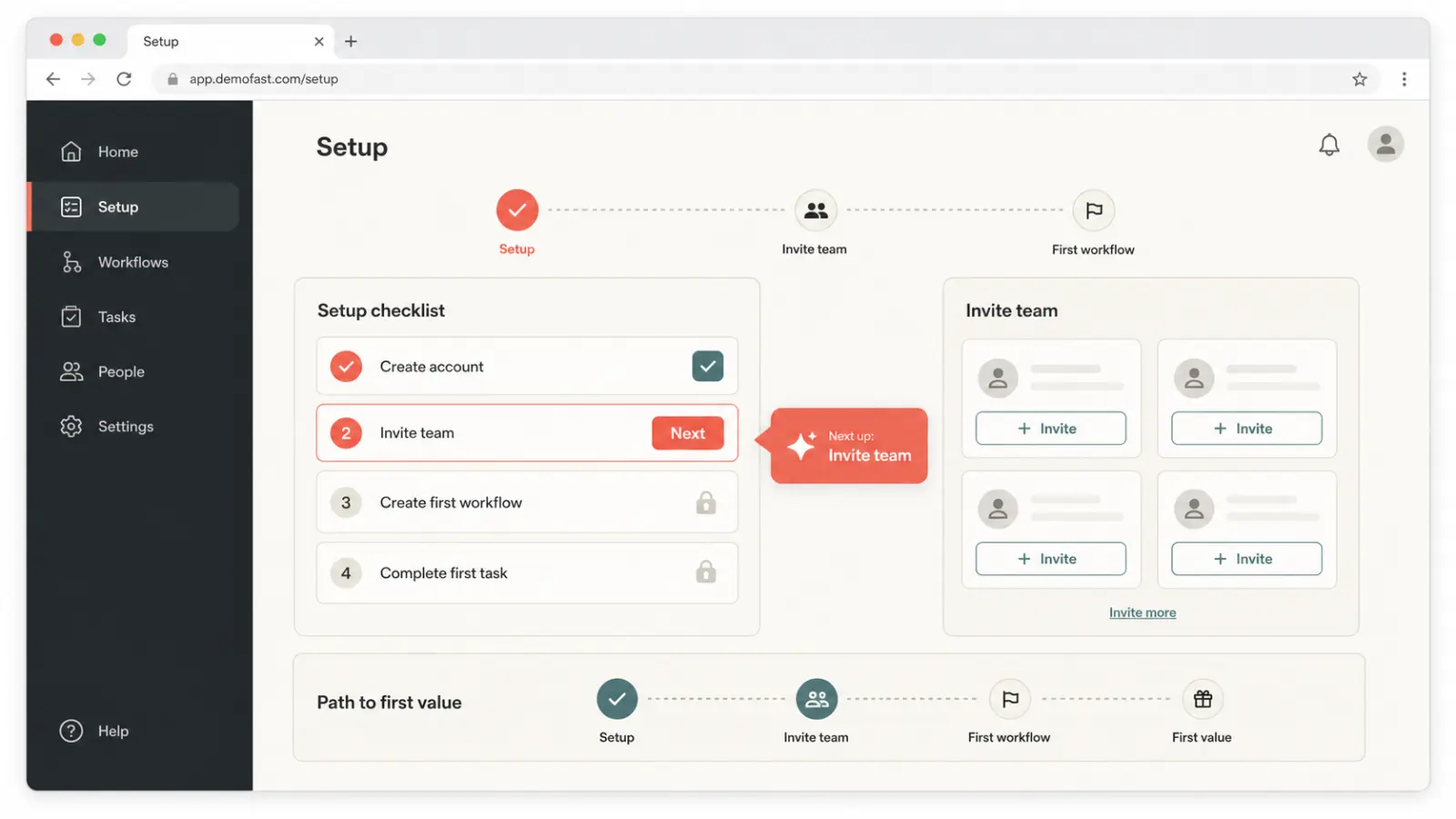
DemoFast lets customer success and product teams create modular walkthroughs around onboarding milestones. Each guide shows the real interface, explains the decision at the relevant step, and can be shared in email, documentation, support replies, or an in-app resource center.
Why it matters
Focus each walkthrough on the action that moves a new customer toward a useful result.
Answer common workflow questions once and make the guide available at the moment of need.
Show the current interface and update individual steps when the product changes.
Product preview
The video runtime loads only after you choose to play, keeping the initial page light.

Customer proof

FeatureShark uses DemoFast for how-to walkthroughs and sales outreach. Tanmay, Founder, reported increased engagement from that work.
Read the FeatureShark storyPractical fit
Help customers complete prerequisites before a live implementation or success call.
Guide account setup, team invitations, integrations, and the first completed workflow.
Create separate paths for admins, managers, and end users rather than one oversized tour.
Add a visual walkthrough to the answer for repeated how-to questions.
How it works
Define the customer outcome and the prerequisites required to reach it.
Record only the actions needed and explain choices that are not obvious from the interface.
Share the guide where the question occurs: welcome email, docs, support, or in-app help.
Publishing checklist
Publishing is the beginning of the asset’s working life. Use this checklist to keep the product story focused, accessible, fast, measurable, and maintainable everywhere it appears.
Define who should use this SaaS onboarding walkthrough experience, the product moment they need to understand, and the one action that should follow. Remove any step that does not advance that job.
Tell viewers what they will learn before asking them to click. The first screen should establish relevance quickly and show enough of the product to earn the next interaction.
Explain audience fit, use cases, tradeoffs, and next steps in accessible HTML around the demo. The page must remain understandable when a player cannot load or a visitor uses assistive technology.
Reserve explicit player dimensions, serve an optimized WebP preview, and initialize interactive or video code only after a click or near-viewport signal. Do not make every embedded asset compete with LCP.
Assign responsibility for product accuracy, links, analytics, and republishing. Review important commercial demos after major UI changes and on a regular content-maintenance cadence.
Measurement plan
A SaaS onboarding walkthrough asset should have a specific job in the customer journey. Record its audience, traffic source, intended product moment, and next action before publishing. That context prevents raw view counts from being mistaken for progress and makes later edits easier to prioritize.
Track whether viewers advance to the screen where the promised value becomes clear. A high start rate with early abandonment usually signals a mismatch between the page promise, opening screen, or amount of guidance.
Measure completion by audience and placement, then review the specific step where people leave. Compare meaningful cohorts rather than combining homepage visitors, sales prospects, customers, and internal reviewers into one average.
Connect the demo to one proportionate next step—start free, request a deeper demo, reply to a rep, read implementation guidance, or try the workflow. Review quality and downstream outcomes alongside clicks.
Decision guide
Use an interactive walkthrough when customers need an on-demand preview they can access before entering the product, revisit later, or share with teammates. It is useful for complex setup and for workflows that should not be practiced in a production account.
Use in-app guidance when the user is already authenticated and needs contextual help on the live screen. Many teams use both: a DemoFast walkthrough for preparation and reference, then lightweight prompts inside the product for immediate action.
Questions
It can remove repeated explanations and prepare customers, while complex implementation, strategy, and account-specific decisions may still need a live conversation.
Place them in welcome sequences, documentation, support responses, learning centers, and any in-app area that can link to or embed the guide.
Usually no. Create modular walkthroughs around distinct milestones so each customer can find the task they need.
Yes. Edit the affected steps and republish instead of replacing an entire recording.